Share the page
AFD Group at COP17
-
When
-
From Monday August 17, 2026 to Friday August 28, 2026
-
Where
-
National Garden Park, Khoroo 26, Bayanzurkh District, Ulaanbaatar 13313, Mongolia
Held from 17 to 28 August 2026 in Ulaanbaatar, Mongolia, the 17th session of the Conference of the Parties to the United Nations Convention to Combat Desertification (UNCCD) will bring together States Parties, international organisations, public development banks, the scientific community, civil society, youth, Indigenous Peoples, pastoral communities and the private sector around a central issue: restoring land to strengthen the resilience of territories and populations.
Adopted in 1994, the UNCCD is the leading multilateral framework for sustainable land management, the fight against desertification and the mitigation of the effects of drought. Alongside the climate and biodiversity conventions, it is one of the three Rio Conventions. It carries a major ambition: achieving land degradation neutrality by 2030.
Held under the theme "Restoring land, restoring hope", COP17 will take place in a context marked by intensifying droughts, growing land degradation, pressure on natural resources and risks to food security. It will also be the first of the three Rio Convention COPs scheduled for 2026, giving it a structuring role in the international environmental agenda.
The AFD Group will take part in this new COP to reaffirm its commitment to sustainable land management, drought resilience, the transformation of agricultural and food systems, sustainable pastoralism, and the coordinated mobilisation of public and private finance.
Land degradation already affects up to 40% of the world's land, with major consequences for food production, water availability, livelihoods, biodiversity and the stability of territories. In Mongolia, host country of COP17, nearly 77% of land is already degraded, making land restoration and the fight against desertification a national and international priority.
COP17 will be structured around several highlights, including a Heads of State summit on 23 August, three ministerial dialogues devoted to finance, pastoralism and drought, and a high-level segment on 26 August.
The main issues to be addressed at COP17 are as follows:
- Accelerating land restoration
COP17 will need to strengthen the implementation of international commitments on land degradation neutrality. Soil restoration, sustainable land management, the preservation of natural resources and the protection of ecosystems will be at the heart of the discussions.
The challenge is to support development pathways capable of preserving land, restoring its fertility, protecting biodiversity and sustaining the livelihoods of the populations who depend on it.
- Strengthening drought resilience
COP16 in Riyadh highlighted the growing importance of drought risk. In Ulaanbaatar, discussions are expected to build on this momentum by promoting a more systemic approach to drought, based on prevention, adaptation, risk management and crisis anticipation.
This will involve better integrating drought resilience into agricultural, water, territorial and climate policies, drawing on sustainable water management, soil health, early warning systems and the adaptation of production systems.
- Mobilising innovative finance for healthy land
The ministerial dialogue on 24 August, devoted to innovative financial mechanisms for land health and drought resilience, will emphasise the need to scale up financing.
Investment needs remain considerable, particularly for family farms, cooperatives, agricultural SMEs and rural territories. Public development banks, agricultural financial institutions, private actors and technical and financial partners will have an essential role to play in channelling more resources towards land restoration and the adaptation of agricultural systems.
- Spotlighting sustainable pastoralism
COP17 will be held during the International Year of Rangelands and Pastoralists, proclaimed by the United Nations General Assembly and supported by Mongolia. Pastoralism will therefore be one of the structuring topics of this edition.
Rangelands cover more than half of the planet's land surface, directly support the livelihoods of hundreds of millions of people and contribute to food security, biodiversity conservation and carbon storage. Yet they remain among the most neglected ecosystems and the most exposed to degradation.
COP17 will thus offer a major opportunity to fully recognise the contribution of pastoral systems and to strengthen public and private investment in their favour.
- Mobilising the private sector around the Business for Land initiative
The Mongolian Presidency intends to give greater visibility to the Business for Land initiative, led by the UNCCD, which aims to accelerate private sector engagement in sustainable land management.
The challenge is twofold: channelling investment towards sustainable value chains and integrating soil health, water conservation, landscape restoration and biodiversity into corporate strategies. The expected participation of international and French companies will make COP17 an important moment for strengthening dialogue between public actors, businesses and civil society organisations.
The AFD Group will take part in COP17 as an actor committed to combating desertification, building climate resilience and driving the sustainable transformation of agricultural and food systems.
The Group will focus its commitments on the following areas:
- Financing sustainable land management and the agroecological transition
The AFD Group supports the transformation of agricultural and food systems in order to reconcile food security, the preservation of natural resources, adaptation to climate change and the economic development of rural territories.
In 2025, the AFD Group's commitments to agriculture, rural development and biodiversity reached €1.3 billion. Projects implemented or completed in 2024 enabled more than 1.3 million family farms to improve their economic performance, nearly 1.2 million family farms to receive support towards agroecological systems, and 2.6 million hectares to benefit from sustainable natural resource and land management programmes.
- Strengthening drought resilience
For the AFD Group, drought should no longer be seen solely as a one-off crisis, but as a systemic risk whose effects have a lasting impact on food security, natural resources, rural economies and the stability of territories.
AFD advocates an approach based on prevention, adaptation and residual risk reduction. This approach involves soil restoration, integrated water resource management, support for irrigated agriculture, the agroecological transition, disaster risk management and the use of nature-based solutions.
- Supporting public agricultural banks and sustainable agricultural finance
Public agricultural banks play a strategic role in financing the transition of food systems, particularly in countries where access to finance remains limited for family farms, cooperatives, rural SMEs and value chain actors.
Through its AGreenFi – Sustainable Agricultural and Rural Financing approach, AFD supports public financial institutions so that they can finance sustainable and resilient agricultural investments. Over the past ten years, AFD has financed more than 25 projects worth around €1.5 billion in this field, combining credit lines, guarantees, technical assistance, risk sharing and institutional support.
AFD is also involved in the Coalition of Public Agricultural Banks, launched at the first Finance in Common Summit under the auspices of IFAD, which promotes the sharing of good practices and the development of innovative tools in sustainable agricultural finance.
- Promoting sustainable, productive and resilient pastoralism
AFD promotes a vision of pastoralism as a sustainable form of livestock farming, based on herd mobility, the sustainable management of natural rangelands and the know-how of pastoral communities.
Far from being a marginal practice, pastoralism is a major lever for food security, climate change adaptation, biodiversity conservation and economic and social development. It also contributes to soil fertility, carbon storage and the productive use of areas poorly suited to crop farming.
At COP17 and during the International Year of Rangelands and Pastoralists, AFD will showcase its experience, its partnerships with Cirad and NGOs, and its projects supporting pastoral development, particularly in West Africa and the Sahel.
- Mobilising public, private and non-profit partnerships for sustainable value chains
Land restoration and the transition of agricultural systems require coordinated mobilisation of public actors, the private sector, producer organisations and civil society.
AFD aims to highlight concrete partnership experiences that reconcile the priorities of partner countries, the needs of producers and companies' sustainable sourcing strategies. Such partnerships can help structure more sustainable agricultural value chains, improve producers' incomes, reduce climate risks and preserve natural resources.
With this in mind, COP17 will be an important opportunity to strengthen dialogue around the Business for Land initiative and to promote value chains that respect soil, water and biodiversity.
The AFD Group will seek to demonstrate its ability to deliver concrete solutions to meet the objectives of the desertification convention and combat drought.
Three side events led or co-led by AFD have been accepted by the organising committee:
-
Building Sustainable Value Chains through Healthy Soils and public and private Partnerships (led by AFD), scheduled for 27 August, 8:30–10:00.
-
Mobilizing public and private sectors for sustainable cotton production in Southern Chad (co-led by LVMH, CBA, the Government of Chad and AFD), scheduled for 25 August, 18:00-19:30.
- Restoring Agricultural Lands and Preventing Degradation: Financing Solutions through Public Development Banks (led by IFAD and AgriPDB, co-organised with AFD), scheduled for 27 August, 9:30–11:00.
AFD will also speak at several side events devoted in particular to pastoralism and sustainable food systems:
-
Pastoralism and rangelands: what prospects does the IYRP declaration offer for COP decisions? (led by CIRAD), scheduled for 25 August at 13:00.
-
Sustainable Pastoralism: The Hydraulic Perspective – Managing pastoral water for sustainable pastoralism (led by the French Scientific Committee on Desertification - CSFD), scheduled for 26 August at 8:30.
- Restoring Land Through Inclusive, Sustainable and Resilient Food Value Chains (led by CGIAR), scheduled for 27 August at 15:00.
Agriculture, rural development and biodiversity:
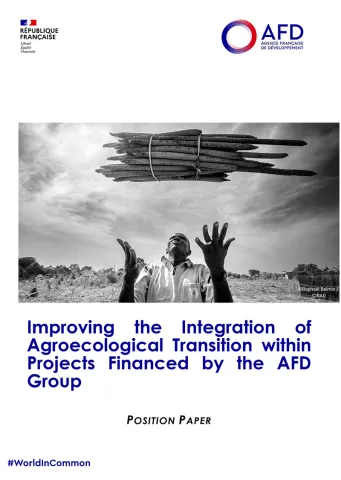
Position paper: Improving the Integration of Agroecological Transition within Projects Financed by the AFD Group
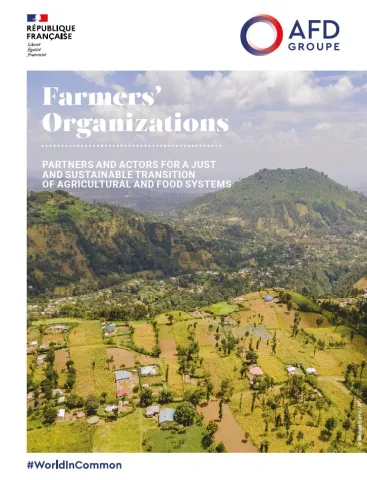
Farmers’ Organizations
 © Michael Goima / AFD
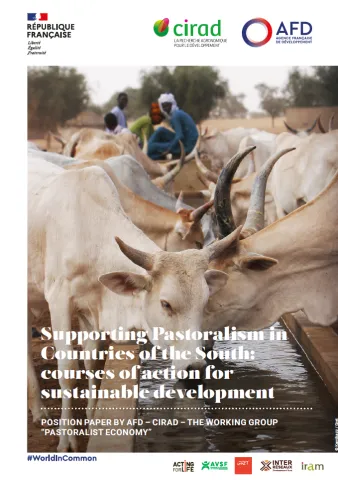
Supporting pastoralism in Countries of the South: courses of action for sustainable development. AFD – CIRAD – Pastoralism Working Group position paper
 Kamikazz / Gret
Examples of projects:
COMBO+: Stopping Net Biodiversity Loss in Six Countries in Africa and Asia
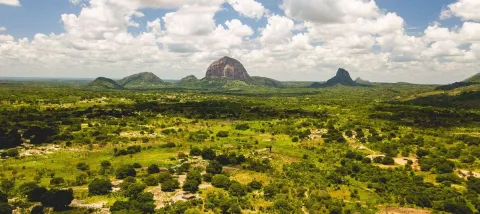 Vue aérienne au-dessus de la communauté de Monea au Mozambique | © Yann Macherez
Research publications:
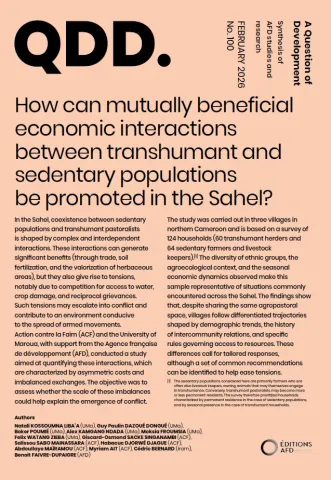
How can mutually beneficial economic interactions between transhumant and sedentary populations be promoted in the Sahel?
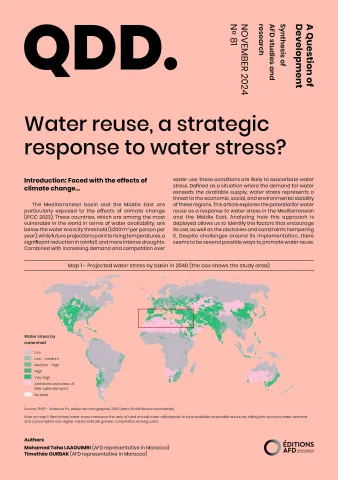
Water reuse, a strategic response to water stress?