Publications and media
AFD and Sri Lanka
Sri Lanka reached the lower middle-income status in 2010 and continued to experience rapid economic growth during the following years. The country alsoexperienced free elections in January 2015 that c...
Published on

Sub-Saharan Africa's significant changes in food consumption patterns
Self-produced food amounts to less than half of the total food that people consume, and the provision of food is therefore largely reliant on market supply, in urban and rural areas alike; domestic fo...
Published on
Are the Cities of Sub-Saharan Africa so Dependent on Food Imports?
Prevalent in discussions of food provision issues in Western and Central Africa is the idea that urban centres in Western and Central Africa are dependent on food imports, and that urbanization is acc...
Published on
Climate : how can a development agency help?
Our planet is warming. Why? Who are the foremost victims? And what are development agencies doing to ensure the transition towards a more low-carbon world? The more humankind goes forward, the more i...
Published on
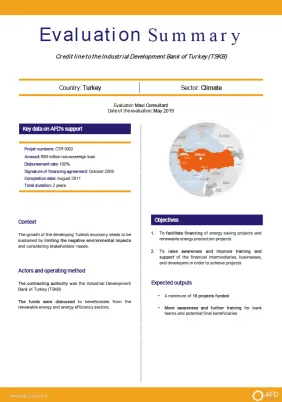
Evaluation Summary - Credit line to the Industrial Development Bank of Turkey (TSKB)
For the “Climate” sector, the credit line to the Industrial Development Bank of Turkey was subject to an evaluation in May 2015. In the context of the Turkish economy’s rapid growth and development...
Published on
The Politics of Results and Struggles over Value and Meaning in International Development
The paper begins with a political history of the 'results’ discourse in the public sector in general and in development aid in particular. It examines perceptions of the effects of the discourse’s art...
Published on
The Impact of Rural Electrification Challenges and Ways Forward
Rigorous impact evaluation that includes appropriately selected control groups must be a part of rural electrification program designs. Budgeting evaluation activities and engaging with evaluators at...
Published on

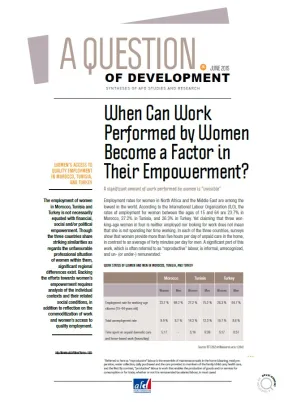
When Can Work Performed by Women Become a Factor in Their Empowerment? - Women‘s access to quality employment ...
The employment of women in Morocco, Tunisia and Turkey is not necessarily equated with financial, social and/or political empowerment. Though the three countries share striking similarities as regards...
Published on
Nigeria: The Restrained Ambitions of Africa‘s Largest Economy
With 180 million inhabitants, Nigeria is the most populous country in Africa. Its economy is also the strongest. Just twice as large as France in size, its people are also very diverse: more than 250...
Published on
Beyond the maps
Through several interviews, this film shows how the African scientific community has appropriated technology to sustainably manage logging in forests, to the benefit of the people living in the Congo...
Published on
World Development Report - WDR 2015 - Progress and Limits
The innovative World Bank Report Mind, Society, and Behavior (WDR 2015) offers great prospects, focusing on the way in which human beings act according to the meaning they give to situations in which...
Published on
Fair Trade? Yes, but not at Christmas! Evidence from scanner data on real French Fairtrade purchases
Responsible consumption based on labels arouses enthusiasm among the community of development (donors, NGOs, researchers, policy makers). Indeed, information provision may appear as a “third wave” of...
Published on
Cities in Climate Change Mitigation Policy
Based on an in-depth review of scientific and institutional literature, this document seeks to identify what urban measures contribute efficiently to low-carbon urban development. It focuses on the co...
Published on
Facing Water Scarcity in the Mediterranean
Pressure on water resources has reached critical levels in many countries in the Mediterranean Basin. Sophisticated water mobilization strategies have been implemented but physical, financial and envi...
Published on
Overextraction of Groundwater Resources: What Are The Solutions?
The amount of water extracted from aquifers worldwide has increased threefold in the past fifty years, leading to an aggravated overdraft of these common resources. This “pumping race” brings about ma...
Published on
Agriculture, Forests and Climate Change: Can Labelling Play a Part?
In the 2009 summit in Copenhagen, the international community agreed to mitigate climate change by assuring that global temperature will not increase more than 2°C between the pre-industrial period (1...
Published on
Agricultural Credit: Assessing the Use of Interest Rate Subsidies
Since the beginning of the 20th century, interest rate subsidies have been one of the tools used all around the world for developing agriculture, especially by major agricultural countries such as Fra...
Published on
Enhancing the Climate Resilience of Africa's Infrastructure : The Power and Water Sectors
This book evaluates -using for the first time a single consistent methodology and the state-of-the-arte climate scenarios-, the impacts of climate change on hydro-power and irrigation expansion plans...
Published on
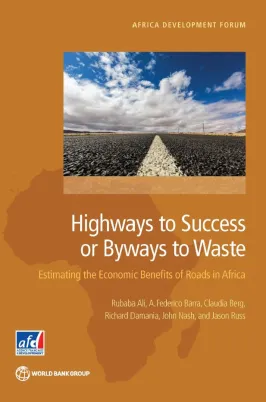
Highways to Success or Byways to Waste : Estimating the Economic Benefits of Roads in Africa
Roads are the arteries through which the world’s economies pulse. Roads connect sellers to markets, workers to jobs, students to education, and the sick to hospitals. Yet in much of the developing wor...
Published on